
 中文
中文 English
 한국어
한국어 日本語
日本語 Español
 Français
 Русский
| Catalog No. | HA561013 | ||||
|---|---|---|---|---|---|
| Description |
AntiHuman Mu-type opioid receptor/OPRM1/μOR Antibody (BMS986122) [BMS986122] (HA561013) is a human monoclonal antibody detecting Mu-type opioid receptor in ELISA, FACS, Functional assay. Suitable for Human.
Highlights
|
||||
| Species reactivity | Homo sapiens (Human) | ||||
| Applications | ELISA, FACS, Functional assay | ||||
| Host species | Human | ||||
| Isotype | IgG | ||||
| Clone ID | BMS986122 | ||||
| Clonality | Monoclonal | ||||
| Target | M-OR-1, MOP, MOR-1, MOR1, Mu opiate receptor, Mu opioid receptor, Mu-type opioid receptor, OPRM1, hMOP | ||||
| Endotoxin level | Please contact with the lab for this information. | ||||
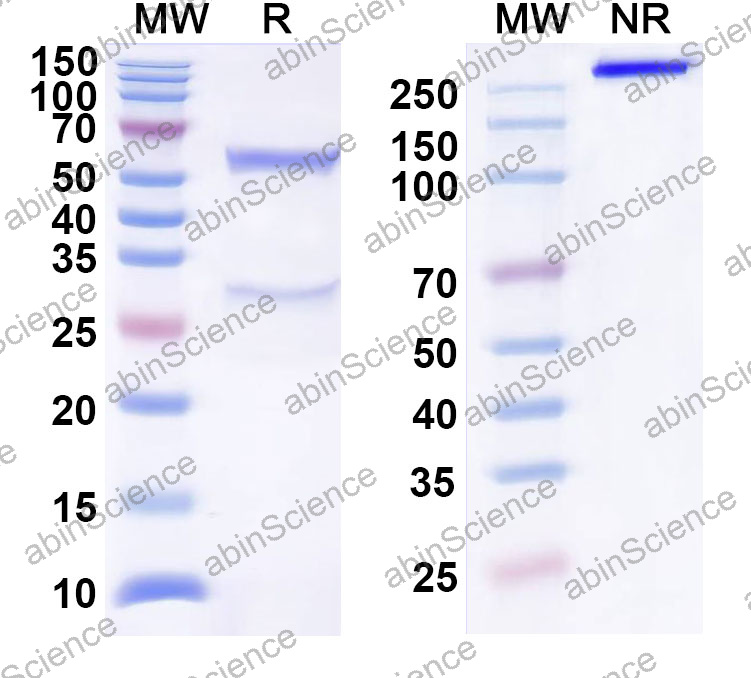
| Purity | >95% as determined by SDS-PAGE. | ||||
| Purification | Protein A/G purified from cell culture supernatant. | ||||
| Accession | P35372 | ||||
| Form | Liquid | ||||
| Storage buffer | 0.01M PBS pH 7.4 Please refer to the specific buffer information in the hardcopy of datasheet or the lot-specific COA. |
||||
| Reconstitution | Reconstitute in sterile water for a stock solution. A copy of datasheet will be provided with the products, please refer to it for details. | ||||
| Product Usage Information |
| ||||
| Stability and Storage | Use a manual defrost freezer and avoid repeated freeze thaw cycles. Store at 2 to 8°C for frequent use. Store at -20 to -80°C for twelve months from the date of receipt. | ||||
| Background | Mu-type opioid receptor (OPRM1) is a ~44 kDa protein. Receptor for endogenous opioids such as beta-endorphin and endomorphin. Receptor for natural and synthetic opioids including morphine, heroin, DAMGO, fentanyl, etorphine, buprenorphin and methadone. Also activated by enkephalin peptides, such as Met-enkephalin or Met-enkephalin-Arg-Phe, with higher affinity for Met-enkephalin-Arg-Phe. Agonist binding to the receptor induces coupling to an inactive GDP-bound heterotrimeric G-protein complex and subsequent exchange of GDP for GTP in the G-protein alpha subunit leading to dissociation of the G-protein complex with the free GTP-bound G-protein alpha and the G-protein beta-gamma dimer activating downstream cellular effectors. The agonist- and cell type-specific activity is predominantly coupled to pertussis toxin-sensitive G(i) and G(o) G alpha proteins, GNAI1, GNAI2, GNAI3 and GNAO1 isoforms Alpha-1 and Alpha-2, and to a lesser extent to pertussis toxin-insensitive G alpha proteins GNAZ and GNA15. 1. Zhang, P. et al. (1999) Brain research. Molecular brain research 72, 195-204. PMID: 10529478 2. Pan, YX. et al. (2003) Biochemical and biophysical research communications 301, 1057-61. PMID: 12589820 3. Mestek, A. et al. (1995) The Journal of neuroscience : the official journal of the Society for Neuroscience 15, 2396-406. PMID: 7891175 4. Wang, JB. et al. (1994) FEBS letters 338, 217-22. PMID: 7905839 5. Bare, LA. et al. (1994) FEBS letters 354, 213-6. PMID: 7957926 6. Bond, C. et al. (1998) Proceedings of the National Academy of Sciences of the United States of America 95, 9608-13. PMID: 9689128 7. Law, PY. et al. (2000) Annual review of pharmacology and toxicology 40, 389-430. PMID: 10836142 8. Lopez, A. et al. (2009) Cellular and molecular life sciences : CMLS 66, 2093-108. PMID: 19300905 | ||||
| Note | For research use only |
SDS-PAGE for AntiHuman Mu-type opioid receptor/OPRM1/μOR Antibody (BMS986122)
Contact us for custom quotes, bulk requests and any other issues.
Mail: support@abinScience.com
+86-27-65523339
Building C, No. 666, Shen Dun Si Lu, Wuhan, 430206, China


