
 中文
中文 English
 한국어
한국어 日本語
日本語 Español
 Français
 Русский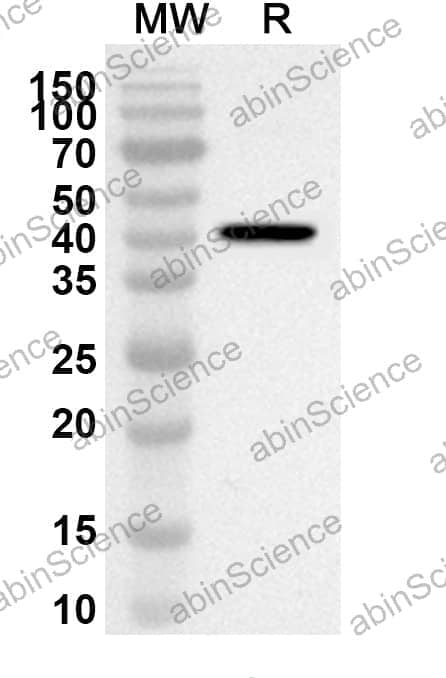
| Catalog No. | HC342014 | ||||||||
|---|---|---|---|---|---|---|---|---|---|
| Description |
Anti-TP53BP1 Polyclonal Antibody (HC342014) is a rabbit polyclonal antibody detecting TP53BP1 in ELISA, IHC, WB. Suitable for Human and Mouse.
Highlights
|
||||||||
| Species reactivity | Human, Mouse | ||||||||
| Applications | ELISA, IHC, WB | ||||||||
| Host species | Rabbit | ||||||||
| Isotype | IgG | ||||||||
| Clonality | Polyclonal | ||||||||
| Immunogen | E. coli - derived recombinant Human TP53BP1 (Ala1614-His1972). | ||||||||
| Target | TP53-binding protein 1, TP53BP1, p53-binding protein 1, p53BP1, 53BP1 | ||||||||
| Purification | Purified by antigen affinity column. | ||||||||
| Accession | Q12888 | ||||||||
| Form | Liquid | ||||||||
| Storage buffer | 0.01M PBS, pH 7.4, 50% Glycerol, 0.05% Proclin 300. Please refer to the specific buffer information in the hardcopy of datasheet or the lot-specific COA. |
||||||||
| Product Usage Information |
| ||||||||
| Stability and Storage | Use a manual defrost freezer and avoid repeated freeze thaw cycles. Store at 2 to 8°C for frequent use. Store at -20 to -80°C for twelve months from the date of receipt. | ||||||||
| Background | TP53-binding protein 1 (TP53BP1) is a ~213 kDa protein. Double-strand break (DSB) repair protein involved in response to DNA damage, telomere dynamics and class-switch recombination (CSR) during antibody genesis. Plays a key role in the repair of double-strand DNA breaks (DSBs) in response to DNA damage by promoting non-homologous end joining (NHEJ)-mediated repair of DSBs and specifically counteracting the function of the homologous recombination (HR) repair protein BRCA1. In response to DSBs, phosphorylation by ATM promotes interaction with RIF1 and dissociation from NUDT16L1/TIRR, leading to recruitment to DSBs sites. Recruited to DSBs sites by recognizing and binding histone H2A monoubiquitinated at 'Lys-15' (H2AK15Ub) and histone H4 dimethylated at 'Lys-20' (H4K20me2), two histone marks that are present at DSBs sites. Required for immunoglobulin class-switch recombination (CSR) during antibody genesis, a process that involves the generation of DNA DSBs. 1. Wang, B. et al. (2002) Science (New York, N.Y.) 298, 1435-8. PMID: 12364621 2. Botuyan, MV. et al. (2006) Cell 127, 1361-73. PMID: 17190600 3. Kang, Y. et al. (2011) Biochemical and biophysical research communications 404, 476-81. PMID: 21144835 4. Chapman, JR. et al. (2012) Journal of cell science 125, 3529-34. PMID: 22553214 5. Escribano-Díaz, C. et al. (2013) Molecular cell 49, 872-83. PMID: 23333306 6. Jacquet, K. et al. (2016) Molecular cell 62, 409-421. PMID: 27153538 7. Drané, P. et al. (2017) Nature 543, 211-216. PMID: 28241136 8. Bigot, N. et al. (2019) eLife 8. PMID: 31135337 9. Swift, ML. et al. (2023) Nature structural & molecular biology 30, 1456-1467. PMID: 37696958 | ||||||||
| Note | For research use only. |
Western blot analysis was performed using anti-TP53BP1 polyclonal antibody at 1ug/mL on recombinant TP53BP1 (Catalog No. HC342012).
Contact us for custom quotes, bulk requests and any other issues.
Mail: support@abinScience.com
+86-27-65523339
Building C, No. 666, Shen Dun Si Lu, Wuhan, 430206, China


